Self Aware NetworksResearch Institute
2D
Research across mind, intelligence, and physical reality

Self Aware Networks Research Institute

Explore research across neuroscience, artificial intelligence, physics, theory of mind, and unified field theory. The Self Aware Networks Research Institute connects these questions through books, papers, and interactive experiences.

  • Neuroscience
  • Artificial intelligence
  • Physics
  • Theory of mind
  • Unified field theory
From the Encyclopedia

Core concepts

Start with the mechanisms. Every card opens its Encyclopedia page here. Drag the ring to spin it.

PWD
Core concept

Phase-Wave Differentials

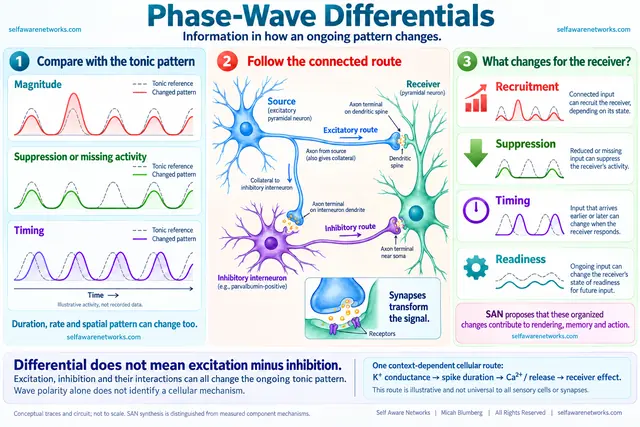
A phase-wave differential is SAN terminology for a typed, receiver-relative neural change with a declared reference, route, physiological denominator, and measurable consequence.

NAP
Core concept

Neural Array Projection

SAN's proposal that an anatomically transmitted source-population pattern is selectively transformed by a receiving population and recurrently re-expressed, rather than copied unchanged from one array to another.

NAPOT
Core concept

NAPOT Overview

Core SAN architecture in which repeated receive-transform-project-update relations express typed, receiver-relative PWDs across distributed perception, memory, and action without an inner viewer.

Tonic · Phasic
Core concept

Tonic Baseline, Phasic Update, and Phase-Wave Differential

A source-faithful account of how ongoing receiver context and typed phasic changes can alter circuit recruitment, effective drive, and embodied action without becoming a global clock or universal phase code.

GCS
Core concept

Gamma Wave Consideration Sandwich

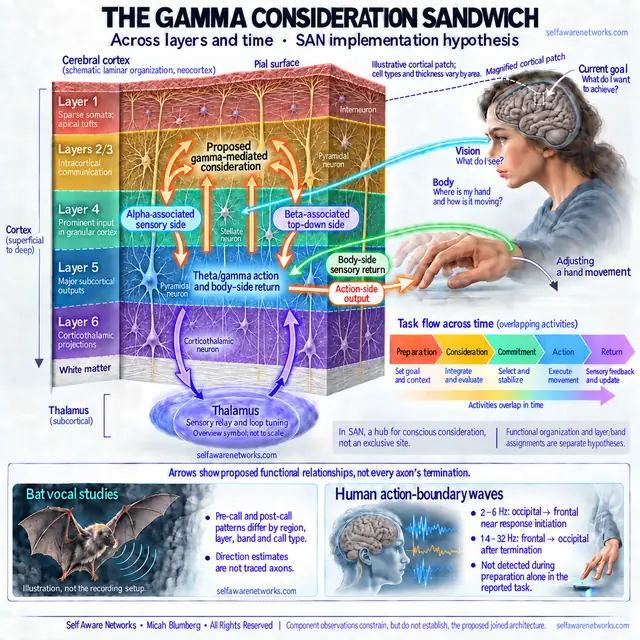
A source-faithful SAN model in which alpha primary-sensory-side input and beta prefrontal thought/top-down input form the top bun, Layer-2/3 gamma consideration and proprioceptive coordination form the middle, and Layer-5 theta/gamma action output plus returned body input form the bottom bun.

Neural rendering
Core concept

Perceptual Screen and Neural Rendering

Seeing is the observer operation of sparse, distributed neural tissue. The system combines changing signals about color, edge, depth, body position, expectation, and action into a usable state, while the same field-cell...

Artificial Neurology
Core concept

Artificial Neurology

Knowing Self: characterize how biological systems receive, transform, retain, and project information.

Information flow
Core concept

The Flow of Information in the Brain

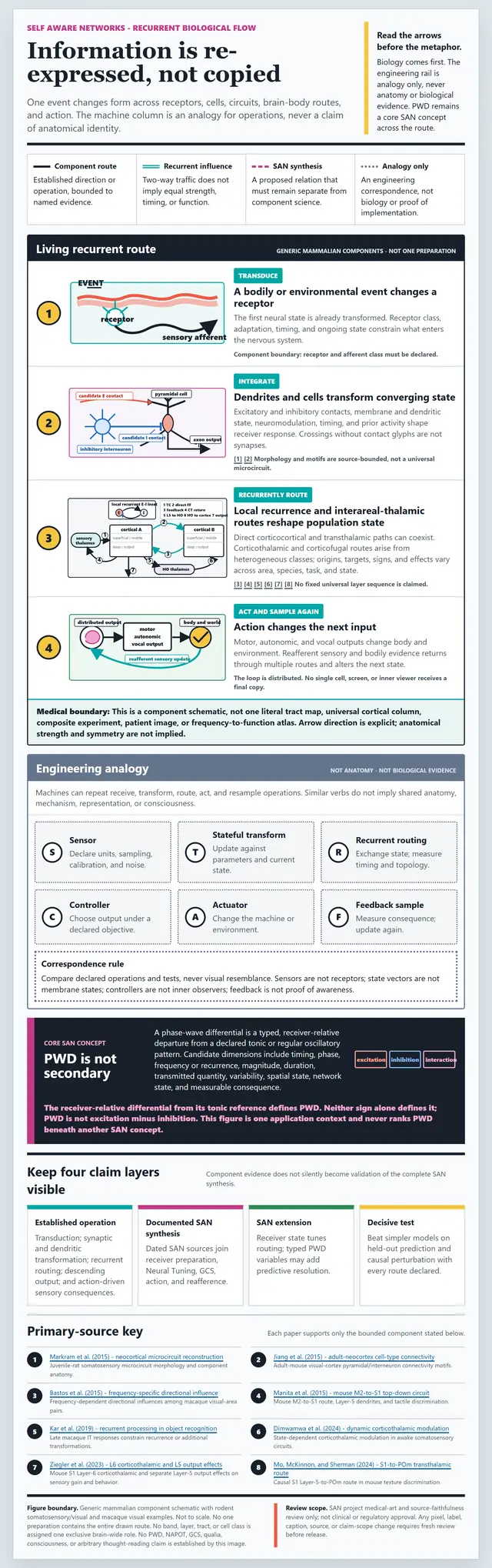
A source-faithful account of how sensory, cellular, circuit, thalamocortical, and motor transformations form a recurrent observer-action loop in SAN.

Choose a reading path

From the Encyclopedia's own guide.

Cover — Bridging Molecular Mechanisms and Neural Oscillatory Dynamics by Micah Blumberg
Earlier book

Bridging Molecular Mechanisms & Neural Oscillatory Dynamics

The first SAN book follows molecular memory, dendritic computation, and neural oscillations across biological scales.

Research reader and spatial experience

Read it. Hear it. Explore it in space.

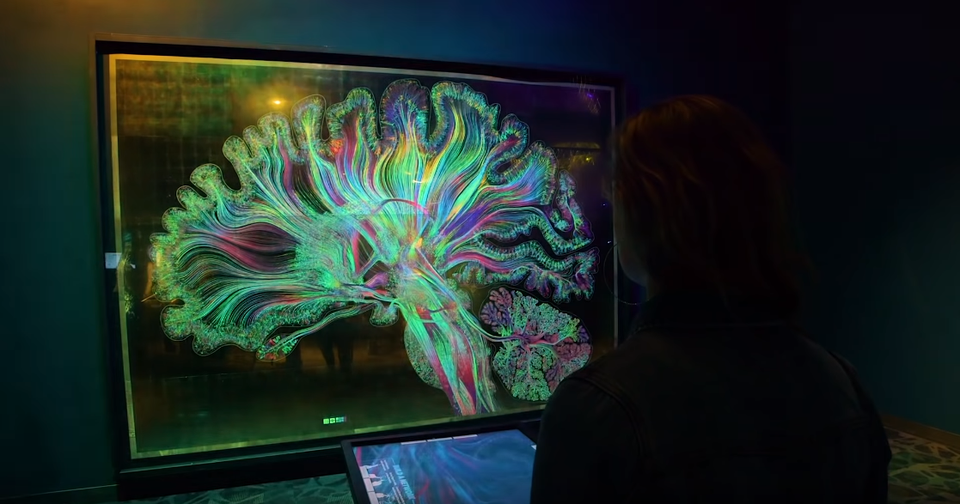
An author-review edition of SAN Book 2 pairs a desktop and phone reader with recorded AI narration and figure-synchronized read-along. The developing project also includes planned high-resolution 3D color graphics and a WebXR walking-museum experience.

Desktop and phone reader

The author-review edition brings the manuscript, figures, source links, and navigation together in a browser-based reading environment designed for desktop and phone layouts.

Recorded AI narration

The author-review read-along keeps each figure in view during its narration, then resumes the reading flow. The book's content and production remain human-directed.

WebXR walking museum

A spatial experience in development for exploring the book's pages and figures as a walk-through museum, with planned high-resolution 3D color graphics.

Living Reference

The Self Aware Networks Encyclopedia

The maintained reader offers curated entry pages spanning foundations, neural rendering, NAPOT, phase-wave differentials, dendritic and synaptic physiology, Artificial Neurology, brain-computer interfaces, NDCA, memory, action, qualia, and source history. This reader collection is an entry path, not a cap on the larger Encyclopedia.

Search all 2,394 pages from the bar above. A page opens here in a focused reader; its address is the page's own Encyclopedia address.

Dated passages, mapped

Comparison Encyclopedia

See how SAN’s documented ideas compare with other research through dated passages, point-by-point mappings, and full source links. Public editions are added as they pass review.

32

Michael S. A. Graziano, Premakumar and coauthors

source-certified partial-comparison links across four dated SAN formulations and two versions of the self-modelling study.

1,089

Hawkins / HTM / Thousand Brains research family

preserved records across 38 target versions, with 18 selected source comparisons.

388

Michael Levin and coauthors

preserved records, with 17 selected source relations across 4 SAN files and 7 target versions.

7

Thalamic oscillations

comparisons with Chowdhury and coauthors’ 2026 preprint.

86

SAN formulations across years

selected comparison links across 15 SAN wording stages and 9 target document versions, on one timeline.

Source review is not human peer review, complete scientific validation, whole-program completion or proof of influence. Dates keep their custody type. Each edition states its own scope.

Join In

Community

Discussion, questions, and ongoing research across the Neo Mind Cycle and Neurophysics communities.

Neo Mind Cycle

The historical public page for brain-computer interfaces, Neural Lace, and Self Aware Networks.

Neurophysics

The historical public page for neuroscience, neurotechnology, and neurophysics research.

Self-Aware Networks

The verified historical community group for SAN and the Neural Lace line.

Neurophysics+

The verified historical group for neuroscience, BCI, and neurophysics discussion.

About the author

Micah Blumberg

Independent AI and neurophysics researcher, founder, systems architect, author, and publisher. Micah connects research with knowledge tools and spatial publishing. His published work begins in 2010; his public research library includes 108 papers across neuroscience, consciousness, AI, physics, and mathematics.

SAN's source history includes work documented before ChatGPT's public release in 2022. Today, AI supports research organization, editing, visualization, coding, and narration as part of a human-directed creative and research practice.

Stay in the loop

Follow the public work

Book announcements, essays, and research updates are published through SVGN. The source repositories preserve the evolving technical record.